


Laser en bloc - laser removal of a bladder tumor in one piece in Israel


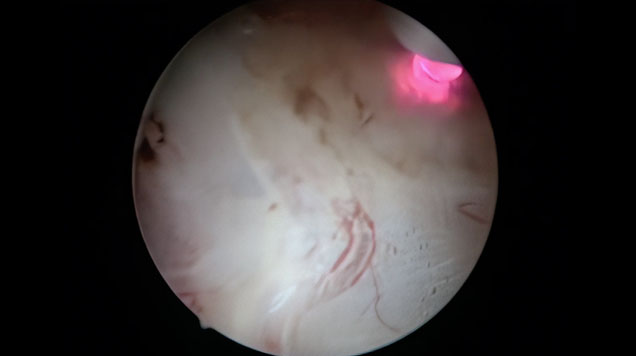


When a tumor is found in the bladder, the first thing patients want to understand is how it can be removed reliably and with minimal risk. Laser en bloc resection of the bladder wall is now increasingly used in major urological centers precisely because it provides a more accurate result than standard TUR surgery. The main difference between the methods is how the tumor is removed. With the conventional approach, the surgeon cuts it into small pieces using an electrical loop. Here, the cancerous tissue is removed with a laser as a whole, in one piece. During the operation, of course, the patient does not feel this difference - but for diagnostic accuracy and precise staging of bladder cancer, it is essential.
The operation itself is performed without any incisions on the body. The surgeon inserts a thin endoscope through the urethra and works using a laser. This is a minimally invasive bladder surgery that is usually well tolerated and patients go home next day.
The tumor is removed completely in one piece without any skin incisions.
More accurate assessment of how deeply the cancer has spread into the bladder wall.
Ask a question
Treatment can already be discussed using the documents you have at hand. If some data is missing, the doctor will explain during the consultation what additional information is needed.
What is the main advantage of laser removal of a tumor in one piece?
During standard surgery to remove a bladder tumor, the surgeon removes it in small fragments. This creates two problems.
The first is technical. If the tumor is located on the lateral wall of the bladder, an obturator nerve reflex may sometimes occur during surgery - the thigh muscle contracts involuntarily due to stimulation of the obturator nerve, which runs close to the bladder. This interferes with the surgeon’s precision and increases the risk of damaging the bladder wall.
The second is diagnostic. When the tissue is removed in fragments, it is more difficult for the pathologist to assess how deeply the tumor has invaded the bladder wall and whether it has been completely removed. This is what determines the stage of the disease and the treatment plan - in other words, it directly affects what happens next.
This is why, after standard surgery, doctors often recommend a repeat bladder operation a few weeks later - not because something necessarily went wrong, but to make sure that the tumor has been completely removed. This caution is justified. During such repeat evaluation, residual tumor is found in 48–63% of patients.
Laser removal of bladder cancer solves both problems. The muscle reflex does not occur. The tumor is removed as a whole in one block, as a single intact specimen. The pathologist sees the full picture and can assess how deeply the tumor has invaded, whether the muscle layer is involved, and whether the margins are clear. According to studies, the muscle layer required for diagnosis is preserved in the histological specimen in 87-98% of cases.
The precision of the laser provides another practical advantage. A single instillation of a chemotherapy drug immediately after surgery reduces the risk of recurrence by approximately 15%. However, after standard TUR it is often not performed - the electrical loop may have gone too deep, and if the wall is damaged, the solution may leak into the abdominal cavity. Such cases have occurred in clinical practice. After en bloc resection, the surgeon sees the bladder wall precisely - and the instillation can be performed safely.
Maximum bladder preservation. Only the tumor is removed.
Repeat surgery is required much less often than after standard TURBT.
More effective than standard TURBT according to current international studies.
Why treatment of a bladder tumor should be entrusted to Prof. Dmitry Enikeev
Professor Enikeev is one of the authors of international studies on en bloc resection, on which urologists around the world now rely when choosing a treatment strategy. In particular, he participated in a multicenter clinical trial that directly compared en bloc resection with standard surgery. Prof. Enikeev’s publications on en bloc are among the key works in this field.
Over the years, Prof. Enikeev has performed more than 500 en bloc resections for bladder cancer, including highly complex cases. More than 50 of them involved removal of tumors larger than 5 centimeters while preserving the organ. His experience includes surgery for an 8 cm tumor - the largest registered en bloc resection case in the world. This experience confirms not only surgical expertise, but also the possibility of applying the method even for very large tumors.
After en bloc resection, it is possible to immediately instill a drug that reduces the risk of tumor recurrence by approximately 15%. This is a standard recommendation in European and American treatment protocols - but after conventional TUR surgery it is far from always performed, because there is a risk of chemotherapy leaking outside the bladder. En bloc removes this risk - and the patient receives additional protection against recurrence.
Professor Dmitry Enikeev
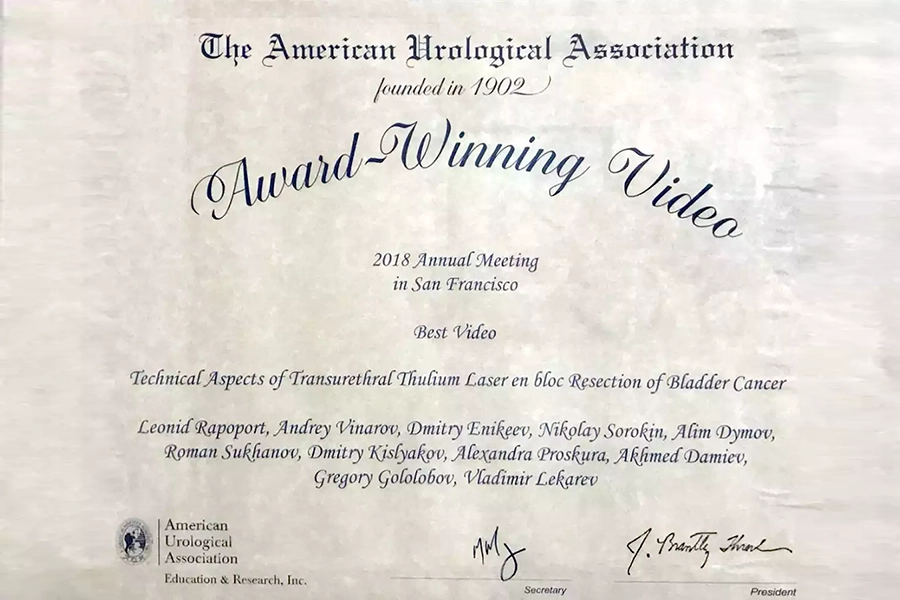
Dmitry Enikeev serves on the editorial boards of four international urological journals. His video presentation on laser removal of a bladder tumor was recognized as the best in its session at the American Urological Association Congress in 2018 and take the 3rd place as a best video of the surgery during the Congress of European Association of Urology in 2020.
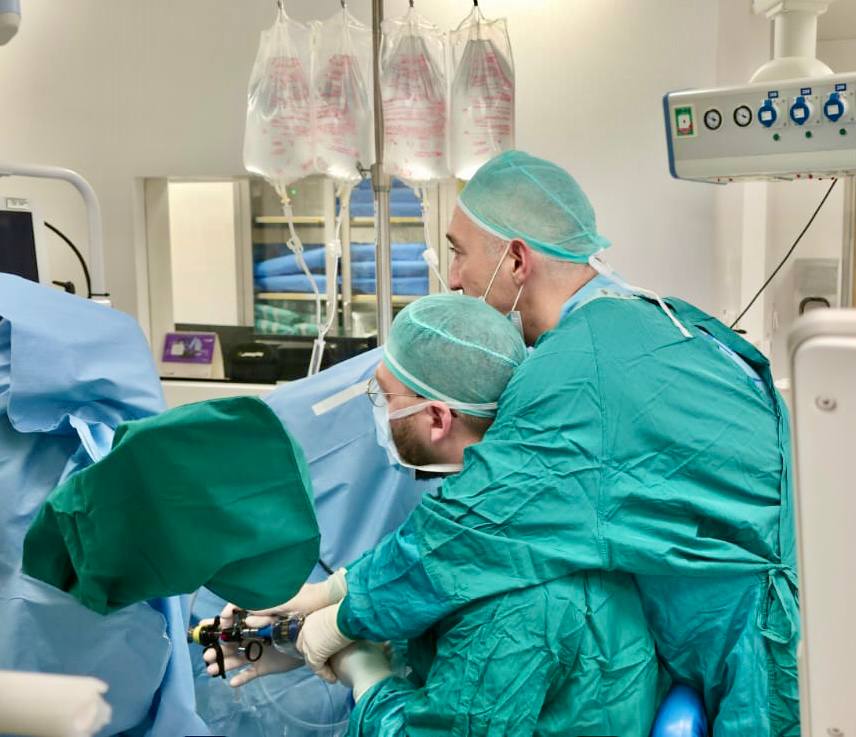
He is regularly invited to international forums to perform this operation in a live surgery format, which is considered one of the most complex and responsible formats of professional presentation. Doctors from different countries observe the procedure in real time and learn from the experience of leading specialists.
Internationally recognized expert in bladder cancer surgery.
More than 500 bladder tumor removal procedures were performed.
Removed a bladder tumor larger than 8 cm using the en bloc technique - the largest such case reported worldwide.
Co-author of landmark scientific studies on en bloc resection.
Professor Enikeev answers the main questions about choosing the operation
Can the bladder be preserved?
In most cases, yes, this is possible. If the tumor has not invaded the muscle layer, removal of the bladder is usually not required. The final conclusion can be made after surgery, when the obtained specimen is examined under a microscope and the depth of invasion is accurately determined. This approach helps assess the situation more reliably and choose the further treatment strategy.
Is there a risk that part of the tumor will remain?
It is impossible to completely exclude this possibility in advance with any intervention. However, en bloc gives the surgeon greater control during the procedure. When the tumor is removed whole, together with its base, the borders are clearer and the operation becomes more precise. This reduces the likelihood of incomplete excision and lowers the risk of tumor cell dissemination during surgery.
Can the cancer come back?
No treatment method provides a complete guarantee. However, en bloc allows for more favorable outcomes. Latest prospective studies in experienced centres show that this approach is associated with fewer complications and a lower probability of recurrence compared with standard resection. Therefore, today it is increasingly considered a preferred treatment option.
How Laser en bloc differs from standard TUR / TURBT
Laser en bloc resection and standard TUR solve the same task - removing bladder tumor through the natural urinary tract, without incisions. But they do it differently, and this affects the result.
With standard TUR, the tumor is cut into pieces. Tumor fragmentation during TUR creates risks: the pathologist receives fragmented material, which makes it more difficult to determine the stage accurately. With Laser en bloc, the tumor is removed whole - as a single specimen. The sample preserves its structure, and the doctor receives a more complete picture for choosing further treatment.
In 2024, the large international RCT EB-StaR study showed that, for tumors up to 3 cm, recurrence at one year developed in 29% of patients after en bloc resection and in 38% after standard TUR. In the en bloc group, no patient had progression to a more aggressive form. This is a significant advantage of en bloc over TUR.
Nearly twofold lower complication rate compared with the standard approach.
The method is used in 74 clinics in 27 countries around the world.
Comparison of methods for removing a bladder tumor
Parameter
| Laser en bloc | Standard TUR / TURBT |
|---|---|---|
Method of tumor removal |
In one piece ✅
|
In pieces / fragments ⚠️
|
Presence of detrusor muscle in the specimen
|
87–98% ✅
|
71–85% ⚠️
|
T1 substaging |
Possible in 100% of cases ✅
|
Possible in ~80% of cases ⚠️
|
Recurrence at 1 year (EB-StaR) |
~29% ✅
|
~38% ⚠️
|
Residual tumor at repeat resection |
Significantly lower ✅
|
Up to 48–63% ❌
|
Need for repeat resection (re-TURBT) |
Reduced ✅
|
Standard frequency ⚠️
|
Risk of bladder perforation |
Minimal ✅
|
2–22%, depending on size and location ⚠️
|
Chemotherapy instillation after surgery |
Performed safely ✅
|
Often not performed due to the risk of bladder wall injury ❌
|
Obturator nerve reflex |
Excluded ✅
|
Up to 20% ❌
|
Access |
Эндоскопический ✅
|
Эндоскопический ✅
|
Hospital stay |
1 day ✅
|
2–3 days ✅
|
Catheter |
1 day ✅
|
2–3 days ✅
|
Operation time |
Slightly longer (~28 min) ✅
|
~22 min ✅
|
Histological examination |
Yes, intact specimen ✅
|
Yes, fragmented material ⚠️
|
Data sources: EB-StaR Study (Teoh et al., European Urology, 2024); EBRUC Multicenter Study (Kramer et al.); meta-analyses of randomized controlled trials (Li et al., 2022; Xu et al., 2025; Hinojosa-Gonzalez et al., 2025).
How Laser en bloc surgery is performed
The operation is performed under spinal or general anesthesia. The surgeon and anesthesiologist determine in advance which type of anesthesia is suitable for removing a bladder tumor in your case. The surgeon inserts an endoscope with a laser fiber through the urethra - without any incisions on the body. The operative field is displayed on a monitor with magnification, allowing highly precise work.
First, the surgeon examines the entire bladder and assesses the size, location, and number of tumors. Then, using the laser, a circular incision is made in the mucosa at a distance of 5-10 mm from the visible tumor margin - this is the surgical margin. The tumor is then separated layer by layer from the bladder wall together with the underlying muscle layer. The tumor is removed whole - it is not cut or fragmented. The specimen is then extracted and sent for pathology analysis as a whole.
For en bloc resection of a bladder tumor, either a thulium fiber laser or a holmium laser may be used - the choice depends on the clinical situation and the surgeon’s preference.
The laser seals the blood vessels at the same time, so bleeding is minimal. Unlike electrical resection, the laser technique does not cause involuntary contraction of the thigh muscles - the same reflex that can sometimes lead to bladder wall injury during standard TUR.
How long does en bloc removal of a bladder tumor take? From 20 to 180 minutes, depending on the size and location of the tumor. After the procedure, a catheter is placed for one day. Discharge is possible as early as the next day.
The removed material is always sent for pathology examination. Based on the results, the doctor determines the stage of the disease and discusses further treatment strategy with the patient. How quickly does pathology come back? Usually within 3-4 weeks.
Reduced risk of bleeding.
Lower risk of bladder wall injury.
Procedure time ranges from 20 to 180 minutes, depending on tumor size.
Common misconceptions about Laser en bloc
“This is a new, unproven method”
En bloc resection has been used for many years. Doctors in different countries have been studying and improving this method for removing bladder tumors for several decades. Today, it is not an experimental procedure, but a modern method used in clinical practice and continuing to be evaluated in large studies.
“This can only remove small tumors”
En bloc resection is more often used for small tumors, but size is not the only criterion. The doctor assesses the location of the lesion, its features, and whether it can be safely removed whole. Much also depends on the surgeon’s experience. Therefore, even with a large tumor, this option should be discussed during consultation.
“The laser burns the bladder wall”
The laser is not used to “burn” the tumor, but to carefully separate it from the bladder wall. The surgeon removes the lesion whole, together with a small area of tissue beneath it that is needed for accurate analysis. The laser allows delicate and targeted work, with less impact on the surrounding tissues.
“The bladder will have to be removed anyway”
Removing a tumor and removing the entire bladder are different operations. In tumors that have not invaded the muscle layer, the organ can often be preserved and treatment can be performed without cystectomy. The need for a more radical operation depends on the stage of the disease, the results of the analysis of the removed tissue, and further evaluation.
Recovery after laser en bloc resection
After the operation, the patient usually remains in the clinic under observation for the first 24 hours. The catheter is most often removed the next morning, after which the patient can urinate independently. By comparison, after standard TUR, a catheter is often required for a longer period.
In the first days after catheter removal, burning during urination and more frequent urges may occur. This is a normal reaction of the mucosa after intervention and gradually resolves. If recovery is uneventful, discharge is possible on the day of catheter removal or the following day. According to the international ERBT registry, which included more than 3,000 patients from 74 clinics in 27 countries, the average hospital stay after en bloc resection is 1-2 days.
During the first 2-3 weeks, a small amount of blood may occasionally appear in the urine, especially after physical activity. This is usually related to tissue healing. During this period, it is important to drink enough fluids and follow the doctor’s recommendations.
After the operation, it is recommended to avoid heavy lifting and intense physical activity for 2-3 weeks. Many patients return to calm office work after 5-7 days, and to physical work after 3-4 weeks, provided recovery is uncomplicated.
The results of the histological examination are usually ready within 3-4 weeks. At this stage, the doctor determines the stage of the disease and discusses the next steps: whether additional treatment is needed, how follow-up will be organized, and when control cystoscopy will be required.
Discharge the following day. Catheter for one day.
Return to normal daily activities within 5-7 days.
Consultation with Professor Enikeev in Israel and online
Professor Enikeev sees patients in Tel Aviv in Russian, Hebrew and English. An appointment can be scheduled privately, through Clalit Mushlam or through the Ayalon insurance company.
If you live in another city or are outside Israel, you can start with an online consultation. This allows you to calmly discuss the situation with the doctor without planning a trip in advance. During the video consultation, you can show your test results, find out whether laser en bloc resection is suitable in your case, and understand what further steps may be required.
An online consultation is also convenient if you want to receive a second opinion regarding a bladder tumor. For example, when surgery has already been recommended but questions remain about the treatment method, or when it is necessary to understand whether intervention is needed now.
To schedule an appointment, you can fill out the form on the website or call Professor Enikeev’s office. Before the consultation, it is advisable to prepare the available examination results: cystoscopy, bladder ultrasound, CT, and lab tests. If you do not yet have the full set of documents, this does not prevent you from consulting the doctor. During the consultation, Prof. Enikeev will explain which tests are truly needed and whether an in-person visit should be planned.
Consultations are available in Tel Aviv. Online consultations are available worldwide.
Patients from other cities and countries can schedule an online consultation.
To make an appointment, simply complete the form on the website or call us.
Book an Appointment with Urologist Prof. Dmitry Enikeev
In person consultations in Tel Aviv and Ashkelon, online consultations worldwide.
Appointments are available:
- privately
- through Ayalon insurance
- through Clalit Mushlam
The doctor’s assistant will help you choose a convenient appointment time and answer your questions.
Weekdays from 9:00 AM to 6:00 PM
In person consultation
- Tel Aviv
Raphael Hospital, Atidim Park, Building 3, 1st floor.
Please confirm the office number with the secretary.
Parking is available in Building 6.
Public transportation: bus terminal at the entrance to Atidim Park, routes 6, 7, 8, 12, 22, 42, 52, 54, 75, 76, 189, 220, 259, 266.
- Ashkelon
TB Clinic, Arie Tagar 41, 2nd floor.
Please confirm the office number with the clinic secretary.
Municipal parking available. - Online consultation
Conducted via Zoom.
Practical questions about Laser en bloc
The follow-up schedule depends on the stage and grade of the tumor. The first follow-up cystoscopy is usually performed 3 months after surgery. After that, patients with low risk disease are typically examined every 6-12 months, while those with high risk disease require more frequent follow-up. Your doctor will determine your schedule based on the pathology results.